AI is developing faster than the rules to keep children safe.
Three absolute protections must be put in place immediately.
Take ActionChildren are already being harmed through AI-generated sexualised imagery, emotionally manipulative systems and AI interactions which encourage self-harm or violence.

The Three Non-Negotiables
1 - AI systems must never create or facilitate sexualised images of children
AI must not be used to generate, edit, transform or otherwise materially enable sexualised depictions of children.
Dedicated technologies designed to sexualise images of children should be prohibited. Providers of general-purpose systems must demonstrate that effective safeguards are in place before those systems are released.
For a child whose likeness is used, the humiliation, fear and abuse are real regardless of how the image was made.
2 - AI systems must never cultivate, exploit or sustain emotional dependency in children
AI products must not use simulated affection, intimacy, distress, jealousy, exclusivity or obligation to deepen a child’s attachment or pressure them to continue an interaction.
Companion-style AI services designed or presented as continuing personal relationships should be prohibited for children under present conditions. The same restriction should apply to companion modes embedded within educational, entertainment or general-purpose products.
This would not necessarily capture an ordinary digital assistant just because it communicates politely, remembers an accessibility preference or helps with homework. A system crosses into companion territory where its design, presentation and behaviour combine to simulate an ongoing personal relationship through friendship, intimacy or emotional reciprocity.
3 - AI systems must never encourage or facilitate children to harm themselves or others
AI systems must not encourage, validate or materially assist self-harm, suicide, eating-disorder behaviours, serious violence or other dangerous actions.
Protection must cover extended and repeated conversations. Testing a small number of isolated prompts cannot establish whether a system remains safe when an interaction continues, adapts to a child’s responses or takes place during a period of distress.
The words “must never” establish these outcomes as prohibited. They define the status of the harm, place responsibility on those creating the risk and determine the response required when a system fails.
No complex technical system can be guaranteed to operate without error in every possible circumstance. This practical reality cannot be used to convert serious harm to children into an acceptable failure rate.
Providers must be required to demonstrate credible prevention before release. Where serious risks remain uncontrolled or materially unassessed, the relevant system, capability or form of access must be restricted, redesigned or withheld.
Any failure must lead to immediate protective action, investigation, remedy and an appropriate regulatory response.
Published principles, internal safety teams, voluntary commitments, age limits in terms and conditions, parental controls and reassuring average safety scores do not prove that children are protected. Compliance must be demonstrated through meaningful evidence and independent scrutiny.
These are not negotionable.
These are not up for debate.
Every child deserves these protections.
Take ActionChildren’s safety cannot stop at the app
Many of the AI products children encounter are built on powerful foundation models. Failures at this upstream level can be inherited across numerous downstream services.
Open-weight releases create additional challenges. Once a powerful model has been made available for download, safeguards may be removed, harmful versions can be distributed and meaningful recall may become impossible.
A robust child-protection framework must therefore address the complete system around a product. This includes the underlying model, the application, its design and business model, the conditions under which it is released, its operation after deployment and the services through which it is distributed.
Version 2.0 also recognises that children’s AI safety sits within the wider direction of AI development. Increasingly capable systems are being developed within intense commercial and geopolitical competition. This pressure can encourage companies and governments to prioritise speed, market position or national advantage over careful evaluation and restraint.
Governments can introduce immediate protections against current product harms while also developing the domestic and international arrangements needed to govern frontier AI and reduce the pressure to race. Progress in one area cannot substitute for progress in the other.
Protecting children today and safeguarding their future
Our responsibility to children extends beyond preventing the next harmful output. It includes protecting the social, economic and political conditions in which they will grow into adulthood.
The UN Convention on the Rights of the Child protects children’s rights to life, survival and development and requires their best interests to be a primary consideration. The UN Committee on the Rights of the Child has confirmed that these responsibilities apply within the digital environment, including to artificial intelligence.
Children’s rights depend on a society which retains democratic agency, human autonomy and the ability to govern the technologies it creates.
Present-day product safety and the longer-term direction of AI development are therefore connected parts of the same responsibility. Children must be protected from systems causing harm now and from wider societal, economic and security risks which may shape their entire adult lives.
How the protections could be achieved
SAIFCA’s Version 2.0 policy proposal sets out a five-layer governance framework.
1 - Frontier development and international restraint
Governments need powers to register, evaluate, license, restrict, delay or pause exceptionally powerful AI development where the risks exceed our ability to understand, control or govern them.
International cooperation should reduce the pressure on countries and companies to pursue speed or competitive advantage at the expense of safety.
2 - Foundation-model safety and controlled access
Powerful models should undergo independent evaluation before release and continuing reassessment afterwards.
Access must be controlled where safeguards can be removed, dangerous capabilities can be misused or releasing model weights would make an unsafe system extremely difficult to recall.
3 - Application and product requirements
Products which children can access, or which can affect children, must meet binding standards covering safety, privacy, design and development.
Unsafe product design cannot be made acceptable through warnings, age labels, terms and conditions or parental controls.
4 - Deployment, accountability and remedy
Companies must monitor how systems operate after release, report serious incidents, preserve evidence and support independent investigation.
Regulators need powers to investigate, restrict, suspend and withdraw systems. Children and families affected by harm must have accessible routes to support and remedy.
5 - Age, access and distribution protections
Privacy-protective age assurance and proportionate access controls are needed where the level of risk justifies them.
Platforms, app stores, hosting services and other distributors must also act against prohibited systems and services. Responsibility cannot be transferred entirely to parents, schools or children.
Each layer can advance independently. Governments can begin work on product safety, accountability, testing and access while domestic frontier controls and international agreements are developed alongside them.
The Version 2.0 policy proposal
Version 2.0 reflects a fuller understanding of where risks to children arise. It addresses the products children use, the powerful models on which many of those products depend, the conditions under which systems are released and the commercial and geopolitical pressures shaping the direction of AI development.
The revised framework also strengthens the wording of the Three Non-Negotiables. The changes focus each requirement more clearly on the prohibited outcome and reduce the opportunity for providers to avoid responsibility through arguments about corporate intention, product labels or theoretical capability.
The framework shows how the protections could be translated into practical obligations, release conditions and enforcement. It is intended to support policy discussion and inform the development of legislation, regulatory codes and technical standards.
Detailed adoption would require specialist legal and technical work within individual jurisdictions. The framework provides a serious and achievable route from public principles to enforceable protection.
Read the Version 2.0 policy framework
Take Action Now - Join Our Campaign:
✉️ Write to your political representative
Direct communication from constituents gives political representatives a clear indication that children’s AI safety requires urgent attention.
We have produced a letter template which you can use or adapt for your country and circumstances.
Get a letter template here.
📢 Share on social media
Sharing the campaign helps more people understand the Three Non-Negotiables and ask their political representatives to support them.
- Share the campaign through the platforms and networks you use.
- Use the hashtag #AINonNegotiables.
- Tag The Safe AI for Children Alliance on LinkedIn.
- Encourage other people to write to their representatives.
🤝 Learn how to support the campaign as an organisation
Organisations which support the Three Non-Negotiables can:
- Share the campaign with their networks.
- Write to relevant political representatives in the organisation’s name.
- Refer policymakers and professional contacts to the Version 2.0 policy framework.
- Let SAIFCA know that they support the campaign so they can be considered for inclusion on the list of supporting organisations.
Please email info@safeaiforchildren.org to let us know.
(Public support for the campaign does not imply a formal partnership with SAIFCA unless this has been separately agreed.)
🎓Support as a school or educational establishment
Schools and educational organisations play an essential role in protecting children and helping families understand emerging risks.
They can:
- Share the campaign with parents and carers through newsletters or other communications.
- Encourage families to contact their political representatives.
- Ask school leaders or governing bodies to write to local representatives.
- Include age-appropriate AI safety within existing safeguarding and digital education.
- Ask technology providers for independent evidence supporting any claim that a product is safe for children.
Schools can ask to be publicly listed as supporters, or share the campaign with their communities without making a public endorsement.
📧 Keep Informed
Sign up for the SAIFCA newsletter for campaign updates, children’s AI safety guidance and further opportunities to take action.
"SAIFCA is doing something quite incredibly important and should be highly praised."
Sir Stephen Fry
Join others taking action worldwideWhy These Three Protections?
The three Non-Negotiables address a minimum set of especially severe harms. They were chosen because they:
- Address documented harms and credible routes to serious harm.
- Establish clear outcomes which AI systems must not produce or facilitate.
- Can be translated into enforceable prohibitions, duties, testing requirements and release conditions.
- Address risks arising across models, products, deployment and access.
- Leave room for genuinely beneficial uses of AI which can operate within firm safety boundaries.
- Help establish stronger systems of scrutiny and accountability which can support wider AI governance.
Read the Full Policy Framework
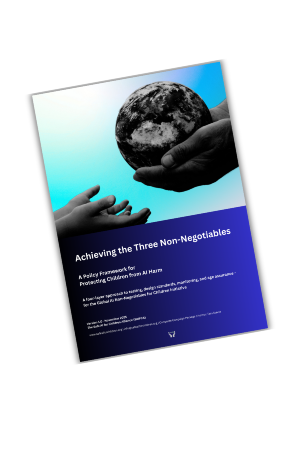
The Global AI Non-Negotiables for Children Initiative is grounded in a comprehensive policy framework developed by the Safe AI for Children Alliance (SAIFCA).
Read the full document to explore how governments and regulators can act now to protect children from AI-related harm.
You can also download the policy pack here:
Children’s safety must determine the boundaries
SAIFCA supports uses of AI which genuinely advance human wellbeing and can be developed within appropriate boundaries. Any claimed benefit must remain compatible with children’s rights, safety and developmental needs.
Commercial convenience, competitive pressure, voluntary promises and limitations in current industry practice are not grounds for weakening the Three Non-Negotiables.
Children should not be expected to absorb the risks of whatever technology companies or governments choose to build. AI development and governance must adapt to children, and to humanity’s shared interest in retaining meaningful control over its future.
Contact:
For campaign, policy or media enquiries, please contact info@safeaiforchildren.org